Super specialization, good or bad?

When I started my journey as a plastic/ reconstructive surgery resident in Germany in 1992, I worked hard to learn as much as possible about this vast field of surgery. My goal was to be the best in everything this fantastic specialization has to offer. Over the many years of learning, practice and mastering the skills required, I started to realize that it is impossible to be the best in everything within any profession.

I had to accept that in order to give my patients the level of service they deserve, I had to consciously limit myself to fewer topics and master them to the highest levels. I call this super specialization. In my case the 2 areas I have accomplished the most is surgery of the face and breast, both aesthetic and reconstructive (admittedly for the last 15 years much more focus on the aesthetic part). Naturally I started to lecture and talk about these two fields more and more not mentioning the many other surgeries I was doing on a daily basis, very successfully. The initial fear of loosing out by not mentioning everything you are capable of performing, was unwarranted. Patients naturally assumed, that if you are the leading surgeon for face and breast in your area, you will also be very good in other surgeries.

I have to conclude, that to super specialize oneself is an advisable move which will in the long run profit both, patients and physicians.


Is medical tourism safe?

We live in a global world and thus it is no surprise that patients, who are seeking medical or plastic/ aesthetic surgeries, look beyond their own country borders.

But why would somebody travel abroad for a surgery? In my opinion there are 3 main reasons:

1) You get abroad the same (or even a better) quality of surgery at a cheaper price.

2) You can’t get a certain surgery in your home country and have therefor to travel abroad.

3) You want to combine holidays with a surgery.

But is it safe to have surgeries outside your own country? The answer depends on different factors. Firstly you have to be sure that you find a reputed clinic with an excellent surgeon. Relying only on review sites can be very dangerous, since you never know how genuine the reviews are. Form your own opinion by researching the doctors’ professional careers and ask questions in case of any uncertainties. I would anyway recommend to talk to the doctor before travelling.

Further you should get informed in detail about the preparation of the surgery, the procedure itself, expected results and you should plan enough time post operation. Returning home too soon may require a follow up consultation with additional costs at a clinic on site, which you may not have budgeted for.

Being in good health before traveling is another important point. If you are suffering from chronic diseases like Diabetes, high blood pressure etc., the risk of complications is higher.

In Dubai, I see many international patients for surgeries, and my team and I make sure that all vital preparations are accomplished before patients, will visit Aestheticon for invasive procedures. Following the above mentioned points will make the experience of medical travel a pleasant one.

Breast Implants And a Natural Look of the Breast are Contradictory?

One of the most common questions I answer during breast enlargement consultations is the question if a breast implant can provide a natural look of the breast! And yes, it is possible, but the doctor needs to know exactly which kind of implant (and there are many different on the market) needs to be used and where to be positioned depending on the findings of the patients.

Anatomic/ tear-drop shaped implants provide the most natural look in many cases, but they are not used frequently in many parts of the world.  The common misconception that implant surgery results in an unnatural appearance of the breast might be due to this fact that anatomic implants are still less often utilized than round implants and that the implant size used is often too big.

Admittedly it requires not only an aesthetic view but also a huge number of executed breast augmentation surgeries to optimize the results, but if these preconditions are given, a breast with a tear-drop shaped implant will look similar to a natural breast – and not “done” at all!

Filler Usage Instead of Permanent Implants for the Face

By the majority of people an attractive and balanced profile is desirable.  There are ideal proportions and measurements in the literature for different kind of populations.  Since the midst of last century implants where used to enhance for example the chin or cheekbone area in the face.

In the wake of the development of tissue-compatible fillers with a slow absorption rate, these fillers have become a suitable alternative to permanent implants with unexcelled advantages. First of all they allow a step wise augmentation until the desired result is achieved. The downtime is very short and the costs are much lower compared to a surgical implant placement. After roughly 9 to 12 months the treatment needs to be repeated.  Thus, in case the patient would not like the result, with time the filler will be absorbed and the condition will go back to normal.

I am a great advocate of filler augmentation due to above mentioned advantages and even advise patients, who want to undergo a permanent implant insertion, to decide firstly on fillers in order to simulate the effect.  Only in very severe cases of hypoplasia, filler may not give the augmentation effect needed or are not stable enough to support the soft tissue.

Breast Reduction Surgery by Preserving the Breast Feeding Ability & the Original Sensation with the Central Pedicle Technique

Women who suffer from enlarged and heavy breasts, which can cause discomfort and pain, will eventually consider a breast reduction surgery.

What holds many of them back is the fear of losing the breast feeding ability and/ or original sensation after the procedure and due to the commonly applied breast reduction surgery methods these are indeed the most common unwanted effects.

There are countless techniques described in the literature with different scar patterns and internal pedicles. The vast majority of these techniques move the areola-nipple-complex upwards based on a skin and subdermal bridge. By doing so, not only the original nerves are severed (cut) but also the milk ducts.

However the central pedicle technique preserves the original nerves and milk ducts, thus preserving sensation and breast feeding ability. At the same time this technique – in the hand of the experienced surgeon – provides superior results in terms of shape and longevity of the result. Only very few surgeons and clinics offer this comprehensive technique routinely.

In summary, you can eat the cake and have it, too: reducing enlarged breasts and keeping the breasts’ fundamental functions intact at the same time.

The Power of Referrals – Not Only Important for Businesses

It is a known fact in the business world, that every business owner prefers new customers through referrals. The reason is obvious: If a friend, colleague or family member refers somebody to you, you will have more trust in the professional competence and sincerity of the recommended person, simply because you have already a bond of trust with the referring person.

Thus, wouldn’t it be logical to apply the same principles to finding the right doctor or clinic? Emergencies aside, everybody should take her/ his time to ask around and seek recommendations from trusted persons, who already consulted a doctor/ a clinic and were happy with the advice/ treatment. This will be a good start to form your opinion.

Once you received the name of the recommended doctor/ clinic, you then should do your due diligence to get to know detailed background information for example by internet research.  The combination of in-person-referral and internet search will increase significantly the chance of finding the best doctor/ clinic and thus getting the best possible advice and or treatment.

On the contrary it is not advisable to simply book an appointment just because you read a tempting offer. In the long run this can be more time-consuming, dissatisfying and even costlier

How to Choose the Right Patient!

We all have come across many articles about “How to choose the right plastic/ aesthetic surgeon” in the mass media, but rarely an article addresses the issue if a patient should be treated or better not.

In my practice, I had thousands of consultations with patients and through the years I became more and more sophisticated in realizing and recognizing the hidden elements during a consultation. My alarm bells start to ring when a patient

– had already undergone countless previous procedures

– is not interested in knowing the possible side effects or complications

– is extremely scared and worried

– does not ask any questions

– wants to tell me what I should do and how I should do it

– bargains too hard.

In any of the above-mentioned cases I put in extra time and effort to make sure that the patient’s motivation to undergo the treatment is right as well as the mindset of him or her.

Due to my professional long-time experience, my general approach is that I only treat a patient, when (of course besides all other preconditions, which need to be fulfilled) my gut feeling is good.

ghofrani-hand-surgery


True Professional Advice Does Not Allow Any Compromises

Patients expect from their trusted physicians that those will advise them in regards of best possible options to achieve best possible treatment results. This is the patients’ right and is anyway the obligation of each doctor. The fundamentals of this right are derived from the Hippocratic Oath, which was written in the late 5th century BC.

From my experience, it is a matter of course that our patients’ needs can usually be satisfied. However, from time to time it can happen, that I need to tell a patient, that her/ his perception of the treatment result is not realistic and thus not achievable. This can be due to different reasons e. g. former misinformation regarding the treatment/ surgical options and expected results or for example the special condition of the respective patient.

If you need to make a decision, which doesn’t meet the patient’s expectations, the patient will understand the reasons and take gratefully the advice, if they feel that you act out of concern for their well being.

Only rarely it happens, that a patient will consult another doctor to hear what she/ he might like to hear, but I truly believe that professional advice for the benefit of the patient does not allow any compromises. Experience shows that those patients, who underwent a procedure elsewhere against better advice, eventually come back to have things rectified.

_mg_0232-crop

Tummy tuck/ Abdominoplasty – How To Do It Right –

We all know what can happen to skin and soft tissue of the abdomen after pregnancy or major weight loss: An unsightly skin flap can remain, which does not respond well to conservative treatments or sport. The only solution to achieve a massive, long lasting and effective improvement is an abdominoplasty, also called tummy tuck.

During the surgery (of a full abdominoplasty e.g.) the total excess of fat and skin below the navel will be removed, the skin above the navel will be pulled down to cover the entire area and for a harmonization of the proportions, the belly button will be re-positioned.

In order to top off the surgical effect and to create a truly flat and toned abdomen with a long-lasting to permanent effect, I tighten routinely in addition the abdominal muscle which will function as an internal bodice. Depending on the case and necessity a liposuction can give the final touch.

The effect is not only visible immediately, but due to the double tightening up, it can be long-lasting or even permanent. Testimonials from patients confirm the longevity of the effect many years after surgery.

In conclusion: For those, who are not happy with their abdominal shape, I would advise to consult a plastic surgeon with a broad professional experience, who is capable to evaluate whether you will need a surgery or not, thus saving you time and money in the long run.

Dupuytren’s Contracture or palmar fibrosis

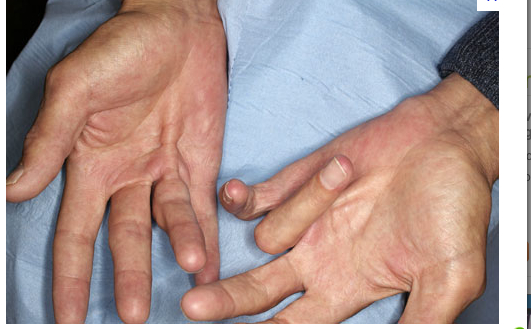
The hand disease called palmar fibrosis or Dupytren’s contracture is seen mainly in Europe, North America and Australia.

The disease leads to a development of connective tissue chords in the palm of the hand, which contract and bend the fingers towards a fist.

We know four stages with stage 1 being the beginning of the disease and stage 4 being the most severe stage with flexion of the fingers above 90 degrees. The exact cause is still unclear but linked to genes.

In the beginning, the disease can be treated by physiotherapy, but usually at some point in stage 2 a surgery is required. During the surgery all affected connective tissue chords will be removed and the underlying nerves, vessels and tendons will be saved.

The recurrence rate can be very high, if a non-experienced surgeon performs the surgery. It is crucial to stress that patients, who are suffering from Dupuytren’s contracture, should consult a hand specialist. Untreated the disease can lead to fingers being fixed to a fist without the ability to use the hand anymore.


dupuytrens-contracture-photo2

Copyright 2009, WebMD, LLC. All rights reserved